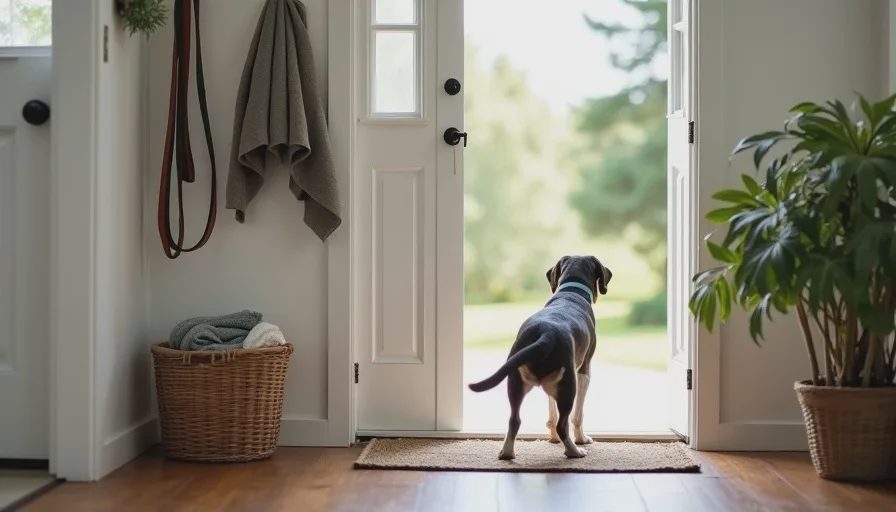
There was a period where I was spending about 40 minutes a day just... resetting.
Not cleaning the whole house. Just putting the pet areas back to zero. Re-stuffing the dog's toys into the bin that had tipped over. Chasing kibble across the laundry room floor. Rebuilding the entryway pile that had collapsed for the fourth time that week. Digging the leash out from under three pairs of shoes. Locating the cat's brush, which had migrated to the kitchen counter for reasons nobody could explain.
Forty minutes. Every day. Just to get back to where I'd started that morning.
I learned this one the messy way.
Here's what I finally realized: the problem wasn't that I had too much pet stuff. The problem was that every pet zone in my house was designed to fail. The bins had no lids. The leashes had no home. The toys had no container that could survive being knocked over by a dog mid-zoomies. Nothing was designed for the reality of a small house with two animals and a kid.
And then I found the standard that changed everything:
If a pet zone can't be reset in three minutes, it's designed wrong.
Not three minutes of grudging effort while muttering under your breath. Three minutes of easy, mindless, second-nature tidying—the kind you can do while holding a coffee cup, one-handed, half-asleep, with a dog following you around.
That's the bar. If your setup can't clear that bar, it's not a small-house pet zone. It's a small-house pet problem.
Let me show you what I mean, zone by zone.
Why "Three Minutes" Is the Right Standard
I want to explain the logic here, because it's not arbitrary.
Three minutes is roughly the length of an average interruption. It's the amount of time you have between walking in the door and needing to start dinner. Between putting the kid to bed and collapsing. Between noticing the mess and losing the motivation to deal with it.
Three minutes is also what you'll actually do when you're tired. On a good day, you'll happily spend 20 minutes organizing. On a Tuesday night in February, after a full workday, when the dog tracked mud in and the cat knocked the water bowl over—you're not organizing anything. You're doing the absolute minimum, or you're ignoring it entirely.
And three minutes means nothing can pile up. A zone that resets in three minutes never gets bad enough to need a full afternoon. That's the actual win. You're not avoiding mess—you're preventing the accumulation of mess, which is what makes a small house feel out of control.
The standard has three parts:
One motion per item. Picking something up and putting it away should be a single movement. No lids to remove, no straps to untangle, no digging under other items.
An obvious home for everything. If you have to think about where something goes, it'll end up on the counter. The cat brush needs a spot that's so obvious your husband could find it.
Nothing stacked. Stacks fall. In a small house with animals, stacks are a promise that you'll be rebuilding them daily.
Apply that to every pet zone and watch your daily reset time drop from 40 minutes to under 10.
Zone 1: The Entryway (The Hardest One)
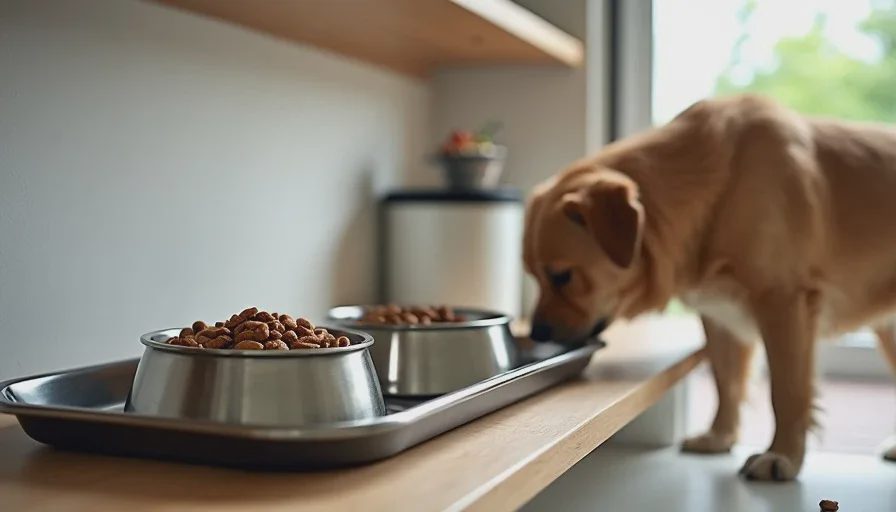
Why this zone fails: It's the intersection of everything. Leashes, poop bags, wet towels, muddy paws, the mail, the kid's backpack, and whatever the dog brought in on her fur. It's also the smallest space in most homes and the one you walk through the most.
What makes it a 3-minute reset:
One wall hook per leash, at eye level. Not a basket. Not a drawer. Hooks. A leash on a hook is a one-second reset. A leash in a basket is a two-minute dig.
A single lidded bin for everything else. Poop bags, treats, wipes, spare towel. Lidded, because a dog can flip an open bin in under four seconds and then you're picking up 400 poop bags off the floor.
A large, washable mat. One big mat, not three small ones. Coarse on top for mud, machine-washable on the bottom.
A small basket for "landing" items that aren't pet-related. This is the key move for small houses. The mail, keys, and kid's things need a home too—or they'll end up on top of the leash hook and slowly suffocate the whole system.
My three-minute reset:
Leash on the hook (2 seconds).
Towel into the bin (2 seconds).
Keys and mail into the landing basket (5 seconds).
Shake out the mat outside (30 seconds).
Done.
What I removed to make this work: A cute open basket for leashes (dog tipped it daily), a decorative shoe rack (became a leash graveyard), and a "leash tree" with six hooks that I never used. Three hooks. That's it. We have one dog.
Small-space adaptation: If you have no wall space by the door, install an over-the-door hook rack. It costs $12, takes five minutes to install, and holds leashes, a towel, and a spare poop bag roll.
Zone 2: The Feeding Station
Why this zone fails: Water spills, kibble scatters, bowls migrate, and the mat slides under the dishwasher. In a small kitchen, the feeding station is usually in the worst possible spot—the walkway—because that's the only floor space available.
What makes it a 3-minute reset:
A tray, not a mat. A mat lets spilled kibble roll off the edges. A tray with raised sides—like a boot tray or a rimmed silicone mat—contains everything. This one change cut my kibble-sweeping by 80%.
Non-slip bowls with rubber bases. Bowls that slide mean water trails across the floor, which means a bigger cleanup than the spill itself.
Food storage directly above or beside the bowls. The scoop, the container, and the bowls should be within arm's reach of each other. If feeding requires walking to another room, it'll always feel like a chore.
A dedicated spot for the scoop. A hook on the wall, or a small clip on the container. Scoops that live loose in the kibble get lost. Scoops that live on the counter get knocked behind the toaster.
My three-minute reset:
Shake the tray over the trash (20 seconds).
Wipe the tray with a damp cloth (30 seconds).
Refill water bowls (30 seconds).
Put the scoop back on its hook (2 seconds).
What I removed: Two decorative ceramic bowls that chipped, a fabric mat that absorbed water and started to smell, and a fancy feeding station stand that made it harder to reach the bowls.
Small-space adaptation: In tiny kitchens, mount a small shelf above the bowls for food storage and the scoop. Vertical space is free space.
Zone 3: The Cat's Corner
Why this zone fails: Cats are clean animals who get blamed for messy areas. Usually the problem isn't the cat—it's the litter tracking, the toys under the sofa, and the fact that the litter box is in a hallway where you can't get to it without contorting.
What makes it a 3-minute reset:
A litter mat with deep grooves. Not a flat mat. Grooved mats catch pellets and litter before it travels. Shake it once a day, done.
An open, low-sided box in a spot you can reach easily. If scooping hurts your back, you won't do it consistently. Make the box easy to access.
A small bin or caddy next to the box. Litter scoop, bags, and a spare liner in one place. One motion to scoop, one motion to bag, one motion to dispose.
One toy basket, not five. Cats are notorious for toy sprawl. One shallow basket, and any toy not in it goes in it during the reset. Cats can still pull toys out—they just also have a target to ignore when you put them back.
My three-minute reset:
Scoop into a bag (60 seconds).
Bag into the trash (5 seconds).
Shake the litter mat outside or into the trash (30 seconds).
Sweep the immediate area (30 seconds).
Toys into the basket (15 seconds).
What I removed: A covered litter box (my cat hated it, and it made scooping harder), a fancy scoop with a rake attachment (jammed constantly), and three different toy bins scattered around the house.
Small-space adaptation: If your only option is a closet or bathroom, use a doorstop so the door stays open just wide enough for the cat and narrow enough to block the dog. That's a $3 fix that solves a $300 problem.
Zone 4: The Toy & Gear Bin (One Bin Rule)
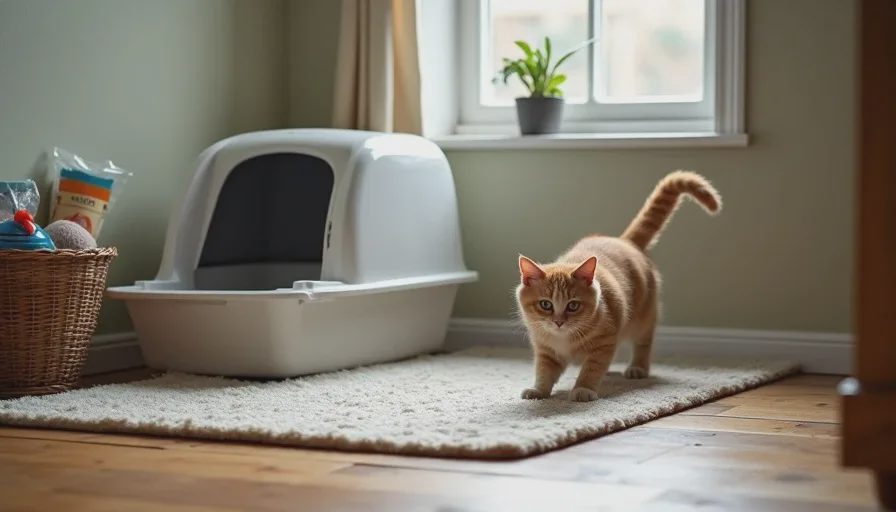
Why this zone fails: Toys multiply. Gear accumulates. And every item needs its own special home, so nothing has a real home at all.
What makes it a 3-minute reset:
One bin per pet. Not one bin per category. One bin per pet, total. If it doesn't fit in the bin, you either rotate something out or you don't need it.
A bin with a lid or a deep-sided basket. Open shallow baskets get dumped by dogs and raided by cats. Deep and lidded means the reset is "throw everything in and close it."
Rotate toys weekly. This is the trick that made the one-bin rule possible. I keep three toys out at a time and the rest in a storage box in the closet. Every Sunday, I swap them. The dog thinks she gets new toys. I get a bin that actually closes.
My three-minute reset:
Everything goes into the bin (60 seconds, including chasing the ball under the couch).
Bin closed and back on its shelf (10 seconds).
What I removed: A toy basket in the living room, a toy box in the bedroom, a "chew toy bin" in the laundry room, and a drawer of cat toys in the kitchen. Now there's one bin in the living room and one rotation box in the closet. That's it.
Small-space adaptation: Use a fabric bin that collapses flat, or a storage ottoman that doubles as furniture. In a small house, everything needs two jobs.
Zone 5: The Cleaning Caddy (Grab-and-Go)
Why this zone fails: Cleaning supplies get scattered—spray in one cabinet, towels in another, bags in a third. So when a mess happens, you spend five minutes gathering supplies before you spend two minutes cleaning. Multiply that by three messes a week and you've lost an hour.
What makes it a 3-minute reset:
One caddy, fully stocked, in one location. Enzyme cleaner, paper towels, microfiber cloths, bags, gloves. All of it, in one carrier.
Restock it the moment you finish, not later. This is the entire secret. A caddy that's empty when you need it is worse than no caddy at all. I restock immediately after every use. It takes 20 seconds.
Keep a small duplicate kit in the car and one in the bathroom. Not a full caddy—just the essentials. Enzyme spray and paper towels. So you're never walking across the house with a dripping mess.
My three-minute reset:
Grab the caddy (5 seconds).
Clean the mess (2 minutes).
Restock and return the caddy (30 seconds).
What I removed: Three separate spray bottles in three separate rooms, a mop bucket that was too big for our closet, and a "cleaning drawer" that became a junk drawer.
Small-space adaptation: A shower caddy or a small tool tote works perfectly. It needs a handle and enough depth to hold a spray bottle upright. Nothing more.
Zone 6: The Muddy Paw Station (Seasonal but Essential)
Why this zone fails: It doesn't exist until you need it, and by then the mud is already on the carpet.
What makes it a 3-minute reset:
A stack of cheap towels right by the door. Not in the laundry room. By the door. If the towel is 15 feet away, you'll skip it and let the dog in muddy.
A shallow basin or boot tray for wet paws. Some dogs will stand in it; most just walk through it. Either way, it catches the worst of it.
A wall hook for a dirty towel so it doesn't end up on the floor or on a chair.
A designated "dirty towel" bin. Once a towel is muddy, it goes in the bin. Never back in the clean stack. This is what keeps the clean stack clean.
My three-minute reset:
Wipe paws (45 seconds).
Muddy towel onto the hook (5 seconds).
Once dry, towel into the dirty bin (5 seconds).
Refill the clean stack from the laundry room once a week (30 seconds).
What I removed: A "pet paw cleaner" cup gadget that my dog hated and that took longer than a towel, and a decorative floor mat that became a mud sponge.
Small-space adaptation: Keep a small stack of 5–6 towels on a shelf above the door instead of on the floor. Vertical, out of the way, and reachable in one motion.
The Reset Audit: How to Find Your Failing Zones
Here's how to figure out which zone in your house needs the redesign. For one week, keep a rough tally:
Which area do you tidy most often? That's your highest-frequency mess, which means it has the highest payoff for redesign.
Which area takes the longest to reset? That's where the design is failing you.
Which area do you avoid dealing with? That's the one that will quietly become a permanent mess. Usually it's the entryway or the cat corner.
Which area do you still have to "think about" when tidying? That means it has no obvious home for something. Identify the item and give it one.
Then apply the same three questions to that zone:
Can each item be put away in one motion?
Does everything have an obvious home?
Is anything stacked?
Fix the answers and you've fixed the zone.
The Small-House Advantage Nobody Talks About
Here's the thing I didn't expect: small houses are actually better for this system, not worse.
In a big house, mess hides. Things drift into spare rooms and closets and get forgotten for months. You can accumulate six bins of pet stuff and never be forced to confront it.
In a small house, there's no hiding. Which means the feedback loop is tight. If a zone is designed badly, you feel it immediately—every single day. That forces you to fix it. And once it's fixed, you feel the relief immediately, too.
Every zone in my house now has a "zero state." I know exactly what it looks like when it's reset. The entryway has a leash on a hook and a towel in a bin. The feeding station has clean bowls on a clean tray. The cat corner has a scooped box and a shaken mat. I can walk through my house in 10 minutes and bring every zone back to zero.
That's not a personality trait. That's not discipline. That's just design.
What I'd Tell My First-Month Self
If I could reset that first chaotic month, I'd stop trying to be more organized and start trying to be better designed.
I spent weeks attempting to be a tidier person. I made lists. I set reminders. I told myself I just needed more discipline. None of it worked, because the problem was never my discipline. The problem was that I'd built six pet zones that were designed to collapse, and then I blamed myself for not being able to hold them up.
The fix wasn't trying harder. The fix was removing lids, adding hooks, buying trays instead of mats, and reducing four toy bins down to one.
Three minutes per zone. That's the whole system. If it takes longer, it's not you. It's the setup. Change the setup.
And then, finally, go sit down. The dog will find you. The cat will ignore you. And the house will hold itself together for the rest of the evening without you.


Letters
No letters yet. Yours could be the first.