
I have a drawer full of training tools that I bought during those first chaotic months.
A clicker I used exactly twice. A spray bottle that made my cat terrified of me. A prong collar that a friend recommended, which I thankfully never used because a trainer told me it was dangerous for a beginner. A vibrating "noise" disc. A shake can. A calming spray diffuser. A bitter apple spray for chewing. A set of bells for potty training.
I spent over $200 on gadgets, gizmos, and quick‑fix solutions.
And not a single one of them made a lasting difference.
I learned this one the messy way.
I kept buying tools because I thought I needed to "correct" something my pet was doing wrong. But the truth was far simpler—and far harder to admit:
My pet wasn't confused about the tools. They were confused about me.
I was sending mixed signals all day long, every day. One day I'd say "off" when the dog jumped on me, but I'd laugh and pet her. The next day I'd say "off" and push her away. The cat got yelled at for scratching the sofa, but the scratching post was tucked behind the laundry basket, collecting dust. The dog got rewarded for "stay" one time and ignored for the same command the next.
No wonder they didn't listen to me. I was completely unpredictable.
Here's what I learned: before you buy another training tool, fix these six daily mixed signals first. Because no gadget can fix communication that doesn't make sense.
Mixed Signal #1: Inconsistent Words
This was my biggest blind spot. I used different words for the same action.
"Off," "down," and "get off" all meant "stop jumping" to me. But to my dog? They were three different, completely confusing sounds.
"Stay" and "wait" meant the same thing in my head. My dog had no idea.
"No," "uh‑uh," and "hey" were all used interchangeably for correction. She'd hear a noise, but had no idea what I was actually correcting.
The fix: Choose one word for each action and stick to it—every single time, by every single person in the house. I created a family "command sheet" and taped it to the fridge. Everyone had to use the same words.
We now use:
"Off" for jumping (not "down").
"Stay" for staying in place (not "wait").
"Leave it" for ignoring things (not "no" or "stop").
"OK" as our release word (not "go" or "free").
If you say different words for the same action, your pet will never learn the connection. They need consistency, not creativity.
Mixed Signal #2: Your Body Language Doesn't Match Your Words
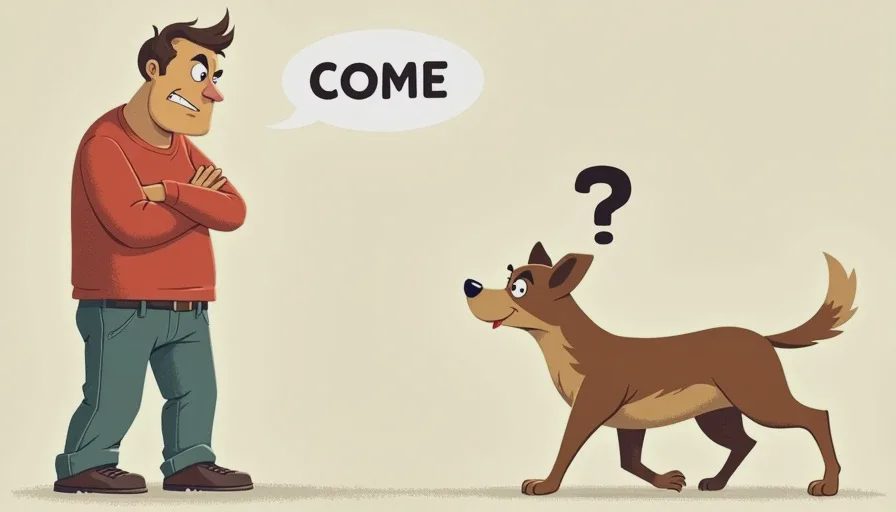
I used to say "come" to my dog while standing completely still, arms crossed, looking stressed. She'd look at me, then walk the other way. I thought she was stubborn.
What was really happening: My body language said, "I'm tense and not inviting you." She read that loud and clear, even though my mouth said "come."
The fix: When you call your dog, make yourself inviting. Squat down, open your arms, pat your legs, smile. Make it exciting. Use a high‑pitched, happy tone. Your body needs to match the message.
Similarly, when you say "no" or "leave it," your tone should be firm but calm—not angry. If you're screaming, your pet doesn't know if they're in danger or if you're just upset. They just know you're scary, and they'll avoid you instead of learning.
Mixed Signal #3: Rewarding Unwanted Behavior Without Realizing It
This one made me cringe when I realized what I was doing.
Example #1: My dog would jump up on me when I came home. I'd say "off" while pushing her away, but I'd be laughing and petting her at the same time. What did she learn? Jumping = attention and petting. She wasn't being "stubborn"—she was being rewarded.
Example #2: My cat would meow loudly at 5 AM. I'd get up and feed her because I wanted to go back to sleep. What did she learn? Loud meowing = food at 5 AM. I taught her that.
Example #3: My dog would bark at the door, and I'd run over to see what she was barking at. What did she learn? Barking = my human comes running. That's a great game.
The fix: Pay attention to what you're reinforcing. If you pet, talk to, or give attention to a behavior you don't want—even if you're just trying to stop it—you're accidentally training it.
The new rule:
Ignore jumping. Turn away and wait until four paws are on the ground. Then give attention.
Ignore 5 AM meowing. No food until you've been quiet for at least 5 minutes.
For barking at the door, don't run to it. Wait for a pause, then reward the silence.
If I could reset the first month, I'd stop giving attention to behaviors I wanted to end. Consistency in ignoring is just as important as rewarding good behavior.
Mixed Signal #4: Not Following Through (The "Empty Command" Trap)
I used to say "sit" to my dog, and if she didn't do it, I'd say it again. And again. And again. Sometimes I'd just give up and do whatever I wanted her to do myself (like open the door or put her leash on).
What my dog learned: "Sit" is optional. My human doesn't actually need me to listen.
The fix: Never, ever give a command you're not prepared to enforce. If you say "sit," you wait until your dog sits. You don't repeat it endlessly. You don't get frustrated. You just wait, maybe guide them into position, and then reward.
If your dog doesn't know what a command means yet, go back to training mode—don't just throw the word out there and hope. Practice in a quiet room with treats, and only use the command when you're ready to reward the correct response.
This was a game‑changer for us. Once my dog realized "sit" actually meant something and she wasn't going to get what she wanted until she did it, she started listening on the first try.
Mixed Signal #5: Praising Too Late
This was subtle, but it messed us up.
I'd tell my dog to "come." She'd run toward me, sniff the ground for a second, look around, and then eventually reach me. I'd give her a treat. She got a treat—but for arriving, not for coming on command. She thought the treat was for just being near me, not for responding to the cue.
The fix: Mark the behavior instantly. I started using a clicker or a clear verbal marker ("Yes!") the exact moment my dog did what I asked. The treat comes right after the marker, but the marker is what communicates: "That action is what earned this."
Timeline for a "come" command:
Dog starts running toward you → you say "Yes!" immediately.
Dog reaches you → you give the treat.
That tiny difference—marking the moment the dog started responding—made her understand that "come" means "move toward me," not "eventually find your way here."
Mixed Signal #6: Letting the Routine Slip (Then Blaming Your Pet)
Some days, I'd walk the dog at 7 AM. Other days, at 9 AM. Some days, I'd feed her right after. Others, she'd wait until I'd had three coffees.
My dog started acting anxious and demanding. She'd pace, whine, and follow me around. I thought she was being "needy."
What was really happening: She never knew when her needs would be met. So she was constantly asking, just in case.
The fix: A predictable daily routine. We now feed and walk at roughly the same times every day. She knows: breakfast at 7, morning walk at 7:30, lunchtime potty break, dinner at 6, evening walk at 7.
The moment I became predictable, her anxious behavior stopped. She stopped pacing because she trusted the schedule. No training tool in the world could have fixed that anxiety—only routine could.
The Tool You Actually Need (And It's Free)
After all those failed gadgets, here's what I landed on as the only truly essential "training tool" for beginners:
A clear, consistent communication system.
That means:
One word per command.
Body language that matches your words.
No accidental rewarding of bad behavior.
Following through on every command.
Marking behavior the exact moment it happens.
A predictable daily routine.
Everything else—clickers, spray bottles, noise discs—is optional. And many of them are actually counterproductive if your communication is already shaky.
Quick Self‑Check: Are You Sending Mixed Signals?
Run through this checklist and be honest:
Behavior | Yes | No |
|---|---|---|
Do you use different words for the same command? | ☐ | ☐ |
Do you give commands while looking stressed or tense? | ☐ | ☐ |
Do you pet your pet when they're doing something you want to stop? | ☐ | ☐ |
Do you give up and not enforce commands? | ☐ | ☐ |
Do you reward too late after the behavior happens? | ☐ | ☐ |
Does your daily schedule vary a lot day‑to‑day? | ☐ | ☐ |
If you checked "Yes" to any of these, fix that before you buy another tool. I promise you'll see more improvement from consistent communication than from any gadget.



Letters
No letters yet. Yours could be the first.