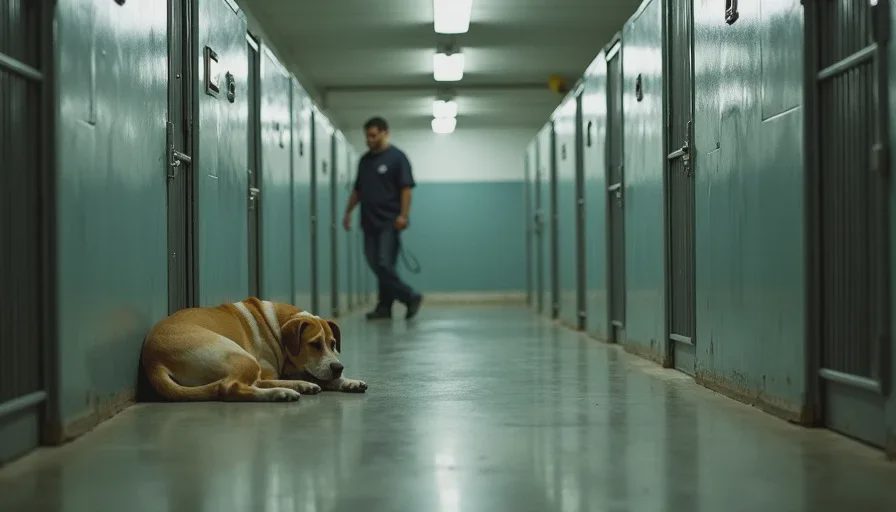
I met my dog in a kennel at the shelter.
She was lying in the back corner of a concrete run, head down, not making eye contact. She didn't jump up when I approached. She didn't bark. She didn't pull on the leash when the volunteer brought her out to the meet-and-greet yard. She walked slowly, sniffed once, and leaned against my leg.
I thought: She's so calm. She's so gentle. She's exactly what we need.
The volunteer agreed. "She's one of our mellow ones," she said.
I learned this one the messy way.
Six days later, that "mellow" dog was doing laps around my living room at 10 PM, chewing the corner of a rug, barking at the dishwasher, and refusing to settle for more than 90 seconds at a time. She was not mellow. She was not calm. She was, in fact, the most overstimulated animal I had ever lived with.
I spent a week convinced the shelter had lied to me.
They hadn't. And that's what made it worse—I couldn't even be angry at anyone. The shelter had shown me the truth. I just hadn't understood what I was looking at.
If you're in that phase right now—where the pet you met is nothing like the pet you brought home—this post is for you.
What You Saw Wasn't Their Personality
Here's the single most important thing I learned, and I wish someone had told me on day one:
A shelter, a pet store, or a foster home is not a neutral environment. It's an extreme one.
Animals behave differently in extreme environments. Sometimes they behave bigger than they really are—barking, lunging, spinning. But very often, especially in shelters and stores, they behave smaller.
They shut down.
Shutting down looks exactly like being calm. The animal is quiet. Still. Doesn't make eye contact. Doesn't react much. Lies in the back of the kennel. Lets you pet them without moving. Walks calmly on the leash, or doesn't walk at all.
To a human, this reads as: mellow, easygoing, gentle.
To a behaviorist, this reads as: overwhelmed to the point of switching off.
And then you bring them home. The noise stops. The other animals disappear. The lights stop flickering. Nobody's barking. Nobody's walking past the kennel every 20 minutes. Nobody's smelling like twelve other dogs.
And the system that was holding all that stress in check—the shutdown—comes offline.
Now you have a dog or cat with a full tank of unprocessed stress, a brand-new territory, and no established routine. And they explode.
The Four Things Actually Happening

Let me break this down properly, because understanding the mechanism is what stopped me from taking it personally.
1. Suppression Is Not Temperament
When an animal is under chronic stress, they have two broad options: fight-or-flight (bark, lunge, run, hide) or freeze/shutdown (go still, go quiet, go flat).
Shelters and pet stores produce a lot of shutdown. There's constant noise, unfamiliar smells, other animals, rotating staff, limited space, and no predictability. For a lot of animals, the safest strategy is to make themselves as small and still as possible.
That's what you met. Not a calm dog. A dog in survival mode.
Once they're in a home—quiet, stable, predictable—the survival mode turns off. And what's underneath is often a young animal with a lot of energy and no idea what to do with it.
2. Sensory Contrast Is Real
A shelter is loud, bright, and chaotic. Your home is quiet, dim, and still.
That sounds like an improvement—and it is. But for a pet who's been living in a sensory storm, the sudden drop in stimulation can be disorienting. And all the energy that was being used to cope is suddenly freed up.
Think of it like this: an animal in a shelter is spending 80% of their resources just managing the environment. At home, that drops to 10%. Now they have 70% more energy than they know what to do with.
That energy shows up as zoomies, chewing, barking, pacing, and "craziness."
3. Sleep Debt Comes Due
Pets in shelters and stores sleep badly. Kennel noise continues at night. Lights are on. Other animals move around. There's no true quiet.
So a newly adopted pet often arrives at your house deeply sleep-deprived—which, ironically, can make them look calm for the first few days.
Then they start catching up. And a pet who has finally slept for the first time in weeks has a lot of energy. This is why week two is often harder than week one.
A well-rested dog is not always a calm dog. Sometimes a well-rested dog is a tornado.
4. Trigger Stacking
Here's a concept that changed how I see everything: triggers stack.
Every stressor adds up. Loud noise, hunger, a strange smell, a new person, a change in schedule—each one raises the baseline. And when the stack gets tall enough, a very small thing pushes them over.
In the shelter, the stack was already tall, and your pet was frozen at the top of it. At home, the stack is lower—but it's being rebuilt every day with new things: the vacuum, the mail slot, the neighbor's dog, the kid's friends, the first bath, the first vet visit.
That's why week three can be worse than day one. The stack has had time to build.
The Actual Timeline (Because Nobody Told Me)

I searched for this everywhere and couldn't find it, so here it is—what most new pet owners actually experience.
Days 1–3: The Shutdown
Your pet is quiet, still, and withdrawn. They hide. They don't eat much. They sleep a lot. You think you got lucky. You did not. This is decompression, not personality.
Days 4–10: The Emergence
They start to come out of their shell. They explore. They eat normally. They start showing interest in toys and people. This is usually the good part. Enjoy it.
Weeks 2–4: The Explosion
This is when most people panic. The energy arrives. The chewing starts. The barking starts. The zoomies start. The accidents happen. The "wild" behavior shows up. This is not a new problem—it's the stored energy finally being released. This is also the period when most pets get returned.
Weeks 4–8: The Rebuild
With routine, exercise, and time, things start to settle. The wildness doesn't disappear, but it becomes manageable and predictable.
Months 2–3: The Real Pet
This is when you finally meet the animal you actually adopted. Not the shut-down version, not the exploding version, but the real one. For most people, this version is wonderful and worth the wait.
This is why the "3-3-3 rule" exists: three days to decompress, three weeks to settle into routine, three months to feel at home.
I didn't know this timeline existed. So I spent weeks 2 through 4 convinced I'd been given the wrong animal.
What "Wild at Home" Actually Looks Like
For dog owners, it usually shows up as:
Zoomies that last longer and happen more often
Destructive chewing (furniture, shoes, baseboards)
Barking at things that never bothered them before
Jumping, mouthing, nipping
Refusing to settle, even when tired
Pacing and panting in the evening
Regression in potty training
Demand barking for attention
For cat owners:
Racing around the house at night
Climbing curtains, knocking things off shelves
Scratching furniture they ignored before
Biting hands and ankles during play
Meowing loudly at odd hours
Sudden bursts of affection followed by swatting
Ambushing feet from under furniture
Here's the key insight: almost none of this is aggression, dominance, or a personality flaw. It's energy with nowhere to go, plus a brain that hasn't learned the house rules yet.
Your pet isn't bad. Your pet is unregulated.
The Five Fixes
Here's what actually helped us. None of it was instant, but all of it worked.
1. Protect Their Sleep
This sounds counterintuitive when you have a hyper pet, but a tired pet is more overstimulated, not less. Sleep deprivation causes dysregulation in animals just like it does in humans.
Dogs need 12–14 hours of sleep a day. Puppies need 18–20. Cats need 12–16.
That means: if your dog is awake and wild at 9 PM, there's a real chance they're actually overtired and needed a nap at 2 PM.
What we did:
Enforced a mid-day quiet period with the crate or a closed room, lights dimmed, white noise on.
Kept evening activity calm for an hour before bed.
Stopped treating every awake moment as an opportunity to interact.
Within four days of enforcing naps, the evening zoomies dropped noticeably. Sleep was the missing piece I hadn't even considered.
2. Give the Energy a Job
An unregulated dog needs an outlet. But "more exercise" isn't always the answer—a lot of "wild" dogs get more wired after intense exercise because it ramps up arousal.
What worked better for us:
Sniffing walks. Twenty minutes of slow sniffing on a long line calms a dog's nervous system more than 45 minutes of fetch. This was the single biggest change.
Chewing. A frozen stuffed Kong or a bully stick. Chewing is a self-soothing behavior.
Lick mats. Licking is also self-soothing. Peanut butter or plain yogurt smeared on a silicone mat, frozen, and given during the witching hour.
Puzzle feeders instead of bowls. Turns a 30-second meal into 10 minutes of problem-solving.
Training sessions. Five minutes of "sit, down, touch, spin" uses more mental energy than you'd expect.
For cats:
Two structured play sessions a day, 10 minutes each, with a wand toy.
End the session with a treat or meal (mimics the hunt-eat-groom-sleep cycle).
Cat trees and window perches—vertical space gives them somewhere to be that isn't the counter.
3. Build a Routine Immediately (Not Later)
I made the mistake of thinking we should "let her settle" before implementing structure. That was backwards. Structure is what helps them settle.
Same wake-up time. Same feeding times. Same potty times. Same walk times. Same bedtime routine. Even if the behavior is chaotic, the schedule stays fixed.
Within a week of a firm routine, my dog started to trust that things were predictable. And a pet who trusts the schedule stops trying to control the environment.
4. Stop Rehearsing the Chaos
Every time your dog gets to practice the wild behavior, it gets stronger. So the goal is to reduce the number of times they get to rehearse it—without locking them in a box all day.
What we did:
Closed off the rooms where she could get into trouble. Fewer chances to practice the behavior.
Used a long line in the yard instead of free run, so she couldn't self-rehearse the fence-barking.
Redirected to a legal chew before the destructive chewing started. Timing matters.
Removed the triggers we could remove. Blinds down before the mail carrier. Vacuum stored in the closet instead of the hallway.
5. Lower the Volume on Everything
An overstimulated pet needs a quieter world, not a more exciting one.
Fewer visitors for the first month.
No dog park visits for the first 4–6 weeks.
No long, exciting outings. Short and boring is better.
Soft voices. Dim lights in the evening. No loud TV or music.
Fewer new toys out at once. Rotate instead of dumping everything on the floor.
I know this sounds like the opposite of what you want to do when your pet is bouncing off the walls. But an overstimulated animal doesn't need more stimulation. They need less, delivered more carefully.
How to Tell Adjustment From a Real Mismatch
This is the question everyone is actually asking: Is this normal, or did I make a mistake?
Here's my honest framework.
This is likely adjustment (give it time) if:
The behavior started after a quiet first week.
It's energetic and chaotic but not aggressive.
Your pet is still eating, drinking, and using the bathroom normally.
The wildness comes in bursts with calm periods between them.
Your pet is affectionate with you when they slow down.
It's improving at all over weeks, even slowly.
This might be a genuine mismatch (get professional help) if:
There's real aggression—biting that breaks skin, hard stares, guarding that escalates.
Your pet is terrified of you, not just overstimulated.
Your household has a safety concern (small children, other pets).
There's no improvement after 6–8 weeks of consistent routine and management.
Your own mental health is seriously deteriorating.
Important: even in the second category, the answer is usually a certified behaviorist or veterinary behaviorist, not a return. Many "mismatches" are solvable with the right support. And if a return is genuinely the right call, working with a rescue or shelter on a responsible rehoming is far better than struggling alone.
The one thing I'd say to anyone in the messy middle: don't make a decision during the decompression period. Weeks 2–4 are the worst weeks. Deciding to return a pet in week 3 is like judging a cake while it's still in the oven.

Letters
No letters yet. Yours could be the first.