Packing for one pet is logistics.
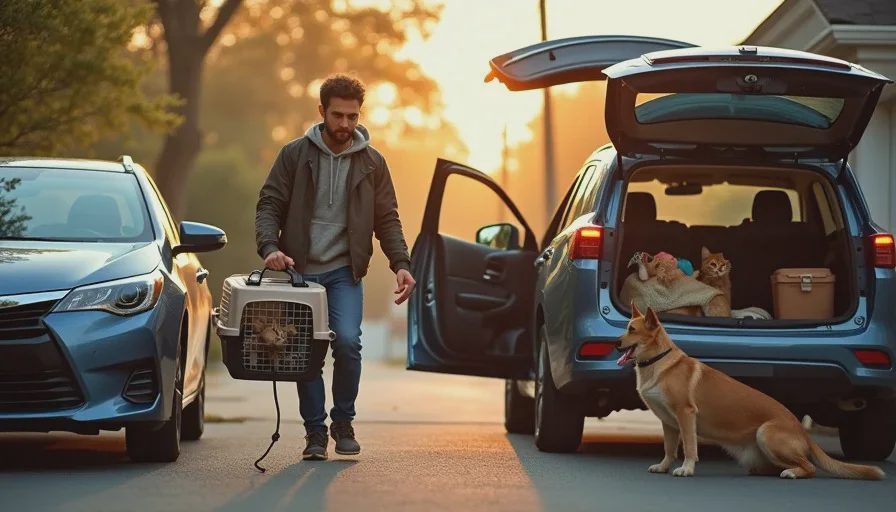
Packing for two pets who don't want to share a car is an entirely separate sport—one with rules I did not know existed until I was standing in my driveway at 7 AM, holding a cat carrier in one hand, a dog leash in the other, and yelling at my husband to grab the cooler.
We were going to my sister's house for one night. One night. Twenty-four hours. And somehow, our car looked like we were emigrating.
The dog was in the back seat, panting. The cat was in her carrier, yowling like I was transporting her to a different dimension. There were bags everywhere, and I had already forgotten the cat's wet food.
I learned this one the messy way.
Here's the truth nobody tells you: a one-night trip is not a scaled-down version of a longer trip. It's its own thing. You don't get the benefit of settling in. You pack almost as much as you would for a week, because the first night anywhere is the hardest—and you'll need everything you'd normally use at home to make it feel normal.
If you're planning a single overnight with both a dog and a cat, here's exactly what we pack now—after two disastrous attempts and one that actually went smoothly.
First, an Honest Question: Should the Cat Even Come?
Before I give you the packing list, I want to be honest about something.
For most cats, the answer is no.
I know that's not what you want to hear if you're planning a family trip. But hear me out.
Cats are territorial. Their sense of safety is tied to their home—the smells, the layout, the hiding spots. A one-night trip means:
A car ride that most cats hate.
A strange space with unfamiliar smells.
No established hiding spots.
New sounds, new people, possibly other animals.
Then, just as they start to settle, another car ride home.
For many cats, the stress of a one-night trip far outweighs any benefit. And there's no benefit for them—they don't want to see your sister. They want to be in their own window.
So before you pack, ask yourself honestly:
Does my cat actually enjoy travel, or do they merely tolerate it?
Is this trip necessary for the cat, or just for me?
Would my cat be safer and happier at home with a pet sitter?
For our household, we've landed on this: the cat stays home unless the trip is longer than three nights or involves a move. For one night, we hire a sitter to come twice, and the cat is infinitely happier.
But sometimes the cat has to come. Moves, evacuations, family emergencies, or a cat who genuinely travels well (there are some). So this post covers both scenarios: the full packing list if your cat comes, and the prep list if your cat stays.
The Core Principle: Replicate Home as Much as Possible
Here's the lesson I learned the hard way after our first failed trip:
Your pet doesn't care about the destination. They care about familiarity.
A one-night trip strips away almost every familiar thing—their bed, their bowls, their litter box location, their routine, their smells. Your job in packing is to bring as much "home" as you can fit in the car.
That's why the list below looks long. It's not about luxury. It's about recreating enough of your pet's normal world that they can relax in a strange one.
The Dog's Kit
Let's start with the easier traveler, because dogs are usually more adaptable—but they still need more than you'd think.
Essentials
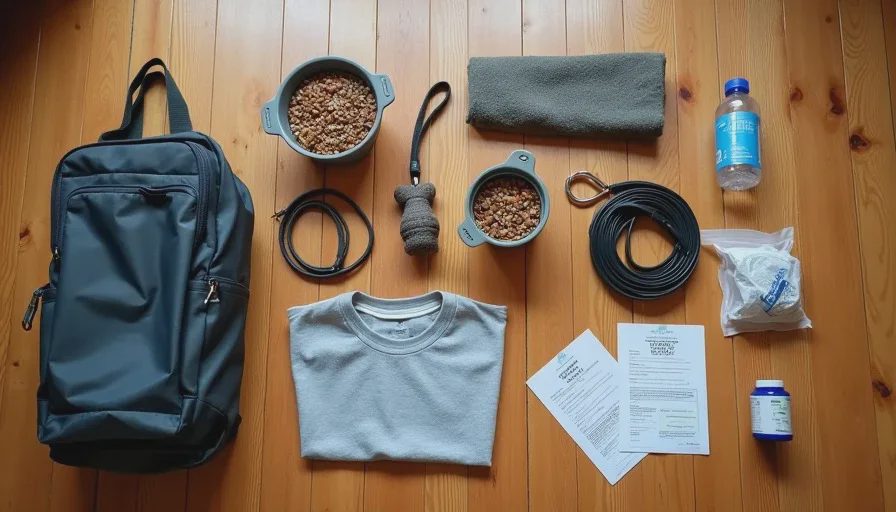
Food: Pre-measured portions in individual zip bags or small containers. For one night, that's two meals plus a few treats. Pre-measuring means no scooping in a strange kitchen and no over- or under-feeding in the chaos.
Water: A collapsible bowl AND a bottle of water from home. Do not use strange water if you can avoid it. A sudden water change can cause digestive upset, and the last thing you want on a one-night trip is diarrhea.
Their regular food bowl: If it fits. Familiar bowls reduce stress at mealtime.
Leash and harness/collar: A 6-foot fixed leash plus a spare. I always bring two because I once lost one at a rest stop.
Poop bags: Double what you think you need. Bring the whole roll plus the backup roll.
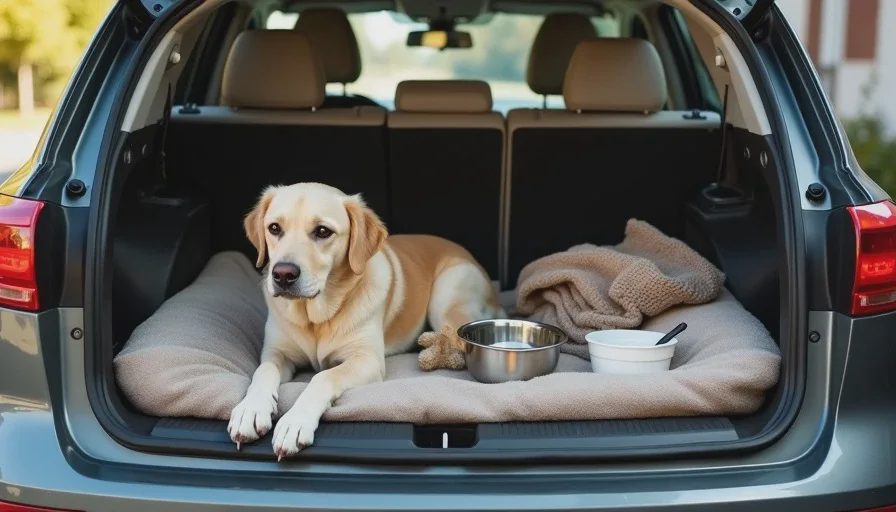
Crate or travel bed: If your dog sleeps in a crate at home, bring it. If not, bring their bed. Whatever they sleep on at home, bring it. This is non-negotiable for us—our dog will not settle on a strange bed.
A worn t-shirt of yours: Sounds sentimental. It's actually a proven comfort tool. Put it in the crate or bed. Your scent is a signal of safety.
Chew toy or stuffed Kong: For the car and for downtime at the destination.
Towel: At least one. Dogs get wet, muddy, or drooly, and you will need a towel.
Waste bags and a small roll of paper towels: For accidents in the car or at the destination.
Medications: Any daily meds, plus flea/tick/heartworm if the trip overlaps with their dose day. Bring a little extra—just in case.
Vaccination records: A printed copy or a photo on your phone. Most boarding facilities and some rentals require proof. Better to have it and not need it.
ID tag check: Before you leave, confirm their tag is secure and current. If your dog is microchipped, make sure the registry has your current phone number.
Optional but Recommended
A long line (15–30 feet): Useful for sniff breaks at rest stops without letting them off-leash.
Paw wipes or a small towel for paws: If your destination has gravel, hot pavement, or mud.
A collapsible travel crate or pen: If you don't want to haul the full crate.
The Cat's Kit
Here's where the packing gets real. Cats need more than people expect, and the items are less forgiving if forgotten.
Essentials
Food: Pre-measured portions, same as the dog. Wet food if that's their normal diet—do not switch foods on a trip. Bring a can opener if you use cans.
Water: From home. Same reasoning as the dog.
Food and water bowls: Familiar ones if possible. Cats can be picky about bowl depth and material.
Litter box + litter: Yes, you have to bring it. A travel litter box (small plastic pan) plus a bag of their normal litter. Do not switch litter brands on a trip. That's a recipe for a cat who holds it for 24 hours and then has a problem.
Litter scoop + bags: For cleanup.
Carrier: Sturdy, hard-sided, top-loading if possible. Top-loading carriers make it easier to get a nervous cat in and out without a wrestling match.
Familiar bedding: A blanket or bed that smells like home. Put it in the carrier.
A worn t-shirt of yours: Same principle as the dog. Familiar scent reduces stress.
A towel to drape over the carrier: For the car. Covering the carrier reduces visual stimulation and helps cats settle.
Any medications: Same rules as the dog. Bring extra.
Vaccination records: Same as the dog.
ID tag and microchip check: Verify before you leave. If your cat gets out in a strange place, this is your only hope of getting them back.
A small toy or two: Something familiar.
Pheromone spray or wipes: Feliway spray on the carrier 15 minutes before travel genuinely helps some cats. Not a miracle, but it takes the edge off.


Letters
No letters yet. Yours could be the first.