You come home and find a frayed phone charger on the floor. Again. Or you lean in to give your cat a little nuzzle and — wow, that breath. If you have an indoor cat, you already know: they get bored, they find their own entertainment, and that entertainment is often your stuff.
The usual fixes — a new crinkle ball, a laser pointer, a cardboard scratcher — buy you maybe a week of enthusiasm before your cat goes back to eyeing the furniture. What most of us miss is that cats have a deep, wired-in need to chew. It is not bad behavior. It is biology catching up with a life spent indoors.
One of the simplest ways to give cats a healthy chewing outlet is silvervine sticks for cats. They are natural, they work on cats who do not care about catnip, and they pull double duty on dental health. Below, we break down how they work and why the WOUSEDO silvervine sticks for cats keep landing in our recommendation list.
Disclosure: As an Amazon Associate, we may earn from qualifying purchases. This does not affect our editorial recommendations.
Why Indoor Cats Need More Than Just a Laser Pointer
Wild and feral cats spend a good portion of their day hunting, catching, and — critically — chewing through prey. That last part gets left out of most toy design. A laser pointer scratches the chase instinct but gives your cat nothing to bite down on at the end of it.
When that chewing drive goes unmet, it gets redirected. Electrical cords. Houseplants. The corner of your couch. None of those are great options, and punishing the behavior without offering an alternative rarely works long-term.
Natural cat dental care toys and chew sticks address this gap directly. They give your cat something acceptable — and genuinely satisfying — to gnaw on. And if that chew toy also happens to clean teeth and ease stress, you are getting a lot done with one small purchase.
For a fuller picture of how to keep an indoor cat stimulated, our indoor cat enrichment guide is a good starting point.
What Are Silvervine Sticks — and Why Do Cats Go Crazy for Them?
Silvervine, also called Matatabi, is a climbing plant native to the mountainous regions of China and Japan. It has been used in Asia as a cat treat for centuries — long before catnip became the go-to in Western markets.
The reason cats respond so strongly to it comes down to two active compounds: actinidine and dihydronepetalactone. These chemicals bind to receptors in a cat's nasal tissue and trigger a euphoric, stimulating response — rolling, head-rubbing, purring, light drooling, zoomies. The whole show.
Here is the important part: catnip only works on roughly 50–70% of cats, and the response depends partly on genetics. Silvervine works on a broader population. Many cats that completely ignore catnip will go head-over-paws for silvervine. That makes silvervine sticks one of the more reliable catnip alternatives for cats.
The typical reaction — drooling, rolling, sneezing, or excited running — peaks within a few minutes and winds down on its own within about 30 minutes. It is not harmful. Your cat is just having a genuinely good time.
What Makes WOUSEDO Silvervine Sticks Different
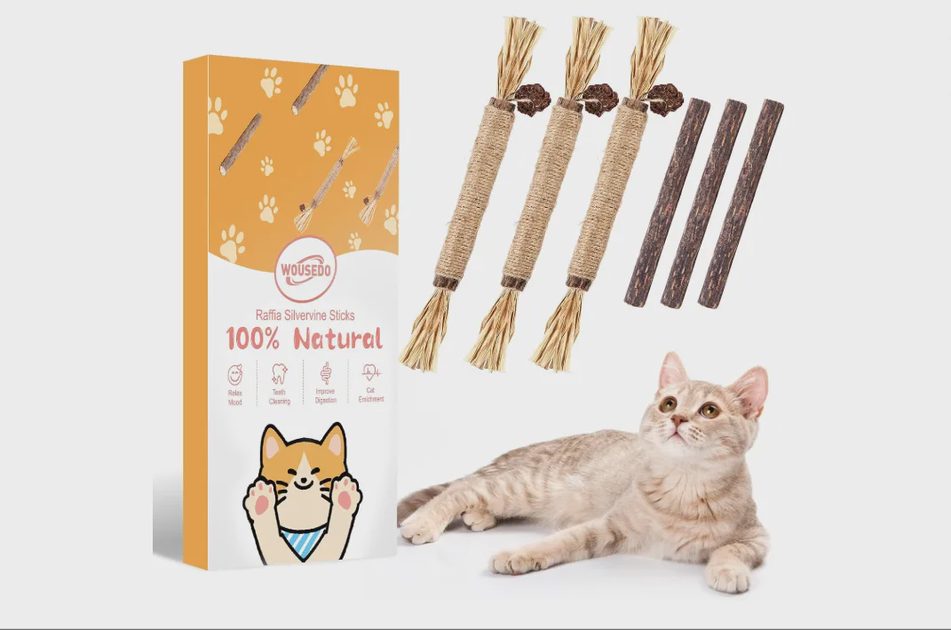
WOUSEDO 6 Pack Silvervine Sticks — natural cat chew sticks with silvervine fruit, sisal rope, and raffia.
There are a handful of silvervine chew products on the market, but this 6-pack of natural cat chew toys from WOUSEDO has picked up a strong following — Amazon's Choice status, a 4.1-star rating from thousands of cat owners, and consistent repeat purchases. Here is what sets it apart.
100% Natural Ingredients
Each stick is made from silvervine wood, silvervine fruit (also called gall fruit), silvervine hay, sisal rope, and raffia grass. No artificial fragrances, no dyes, no chemical additives. What your cat chews on is what grows in the ground.
Dental Health Support
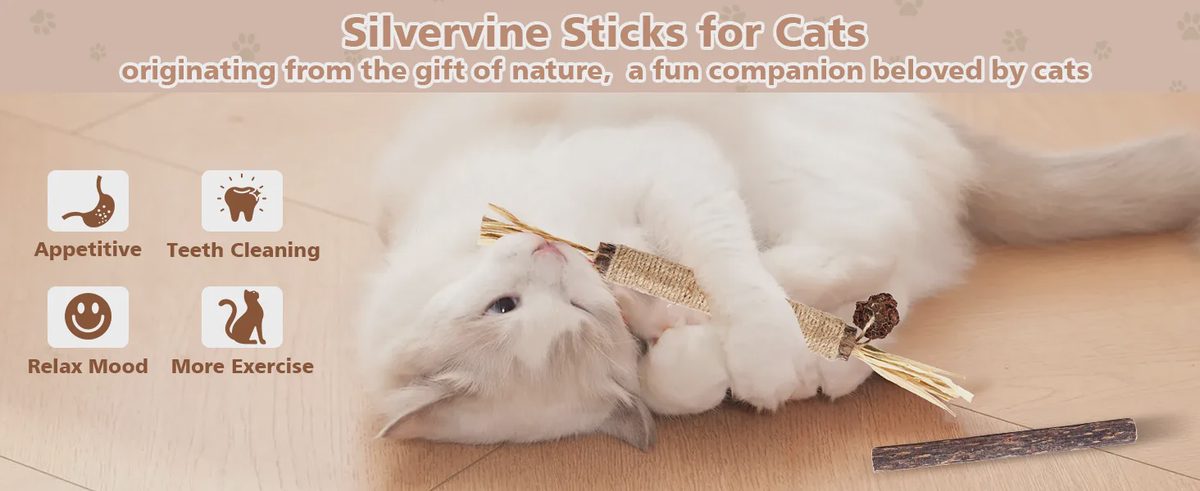
Chewing the fibrous stick creates a mild mechanical scrubbing action on tooth surfaces. Over time, many cat owners find this helps reduce plaque and tartar buildup, freshens breath, and supports healthier gums. It is not a replacement for veterinary dental cleanings, but it is a meaningful daily habit. Our cat dental care guide covers the full picture.
Stress and Anxiety Relief
The actinidine in silvervine acts as a natural mood elevator for cats. If your cat tends toward anxiety — around strangers, loud noises, or life changes — giving them a silvervine stick to focus on can help them settle. It is a natural cat enrichment tool that does not require any training or setup.
Digestive Benefits
The plant fiber in these sticks can help move things along in your cat's digestive tract — including hairballs. If your cat is a heavy groomer, adding a chew routine may help reduce the frequency and severity of hairball incidents.
A Safe Outlet for Destructive Chewing
This is the practical one. When your cat has a silvervine stick to work through, they are less likely to go looking for your laptop charger. You are not training the chewing out of them — you are just giving it somewhere acceptable to go.
Real-World Scenarios
The Cable Chewer
Your cat has figured out that the phone charger by the desk makes a satisfying crunch. You have tried moving it, taping it down, yelling — nothing sticks. Try leaving a silvervine stick near the spot where the chewing usually happens. Many cat owners find that redirecting the chewing urge to a dedicated chew stick takes the pressure off the cords within a week or two. The key is consistency: offer the stick proactively rather than waiting for the bad behavior to start.
The Cat With Bad Breath and Gunky Teeth
If you have noticed your cat's breath has turned, and their teeth look like they are developing a yellowish film, a silvervine chew routine can be a first line of defense between vet visits. The fibrous texture works against the tooth surface as your cat chews. Combine it with a vet check if the buildup looks significant — but for everyday maintenance, natural cat chew sticks are a low-effort habit worth building.
The Anxious Cat
New apartment. New baby. A second cat joining the household. Cats handle change about as well as the rest of us, which is to say — poorly. A silvervine stick can help take the edge off. The active compounds in the gall fruit produce a calming euphoria that many anxious cats respond well to. It will not fix a serious behavioral problem on its own, but as a daily stress management tool, it is worth having around.
Specs at a Glance
Spec | Details |
|---|---|
Brand | WOUSEDO (also shown as WUSEDO) |
Product | 6 Pack Silvervine Sticks for Cat, Natural Catnip Toy |
Pack Size | 6 sticks |
Materials | Silvervine stick, silvervine fruit (gall fruit), silvervine hay, sisal rope, raffia grass |
Stick Dimensions | Approx. 0.25 cm × 0.25 cm × 0.25 cm (thin chew stick format) |
Package Dimensions | 6.77 × 3.78 × 0.71 inches |
Weight | 2.11 oz (59.82 g) |
Suitable For | Cats 2 months and older, all life stages |
Additives | None — 100% natural |
Market Recognition | Amazon's Choice; 4.1 stars from thousands of verified buyers |
Who It's Best For (and Who Might Want Something Else)
No product works for every cat. Here is an honest breakdown.
Good fit
Indoor cats with limited stimulation
Cats that chew furniture, cords, or houseplants
Cats with early plaque buildup or mild bad breath
Cats that ignore catnip
Anxious cats or cats adjusting to change
Kittens 2 months and older learning healthy chew habits
May not be ideal
Cats with known plant allergies (check with your vet)
Cats that have no interest in chewing at all
Cats with severe dental disease (vet treatment first)
Households wanting a zero-mess solution (the sticks do leave small fibers)
The 98% acceptance rate cited by the brand is optimistic — our honest read is that most cats respond positively, but a small number may need some encouragement, and a few will not respond at all. That is true of nearly every cat enrichment product.
Final Thoughts
If your indoor cat is bored, chewing things they should not, dealing with bad breath or tartar, or just seems like they need something new to engage with — silvervine sticks for cats are one of the more straightforward upgrades you can make.
WOUSEDO's 6-pack covers multiple real problems at once: it gives your cat a legal chewing outlet, supports daily dental hygiene, and delivers a natural mood boost that works on cats who do not respond to catnip. The fact that it is made from entirely natural materials, with no additives, makes it easy to recommend without reservation.
It is a small thing that many cat owners say makes a noticeable difference — fewer chewed cords, fresher breath, a cat that seems more settled. That is a good return for a few dollars and a minute of your cat's undivided attention.
Thousands of cat owners have tried these silvervine cat sticks on Amazon — see their reviews and current pricing before you decide.


Letters
No letters yet. Yours could be the first.