
I have a note on my phone from night four.
It's timestamped 3:41 AM and it just says: "I can't do this. I think I made a mistake."
I didn't send it to anyone. I just typed it and stared at the screen while my rescue dog paced the bedroom, panting, and my cat yowled from the hallway. My husband was asleep. My daughter was asleep. Everyone in my house was resting except me and the two animals I had apparently ruined my life for.
I was convinced I was failing.
Not because my dog was misbehaving—she wasn't. She was scared. Not because my cat was being difficult—she wasn't. She was disoriented. But because I had absorbed a myth so completely that I never questioned it:
That a normal, well-adjusted pet sleeps through the night. And if yours doesn't, you're doing something wrong.
I learned this one the messy way.
Here's the truth I wish someone had told me at 3:41 AM: newborn routines aren't the only thing that gets disrupted when a life changes. Every new pet goes through a sleep adjustment period—and it's not a sign of failure. It's a sign that they're alive and adapting.
Let's talk about the myth, where it comes from, and what actually helps.
The Myth: "If You Do It Right, They'll Sleep Through the Night"

You've seen the version of this online. A photo of a puppy asleep in a crate at 8 PM, captioned something like: "Night three and he's already sleeping 10 hours straight!"
There are a few problems with this:
1. It's usually not the whole story. Those posts rarely mention the 20 minutes of crying before the puppy passed out, or the 5 AM wake‑up, or the fact that the owner slept on the floor next to the crate.
2. It's survivorship bias. Nobody posts: "Night three and I'm crying in the bathroom." So all you see are the easy stories, and you assume your experience is the anomaly.
3. It ignores biology and history. Your pet didn't come from a quiet, temperature‑controlled bedroom with blackout curtains and a white noise machine. Shelter dogs sleep in kennels with constant noise. Shelter cats sleep in rooms with dozens of other animals. Strays sleep lightly, always on alert. A pet who slept through the night in their first week would be the strange one.
4. It confuses sleep with compliance. A pet sleeping through the night isn't a sign of good training. It's a sign of feeling safe. And safety is earned over weeks, not days.
What Actually Happens in the First Two Weeks
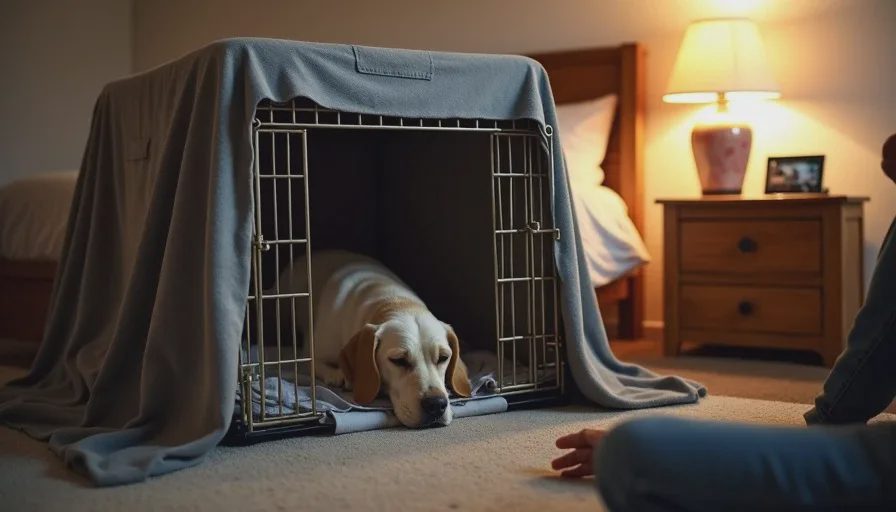
Here's what real sleep looks like for a new pet—and their human—in those first weeks.
For Dogs
Nights 1–3: Expect very little sleep. Your dog is in a new place with new sounds, new smells, and no established territory. They may pace, pant, whine, cry, or bark. They may refuse to lie down. They may only settle if you're within sight.
Nights 4–10: Slight improvement. They start to recognize the bedtime routine—last potty break, lights dimmed, crate, quiet. They may still wake once or twice, and they may still need a middle‑of‑the‑night potty break (especially puppies and seniors).
Weeks 2–4: Better. A predictable schedule starts to take hold. They sleep longer stretches. You might get five or six uninterrupted hours.
Weeks 4–8: Noticeably better for most pets. Some dogs are fully settled by week six. Some take three months. Both are normal.
Reality check: If your dog came from a shelter, they may have been sleeping in a noisy environment with lights on. Silence and darkness can actually be unsettling at first. That's why white noise and a covered crate often help.
For Cats
Cats are crepuscular, which means they're naturally most active at dawn and dusk. This is not a flaw—it's how they're built.
Nights 1–7: Your cat may be awake for most of the night. They may meow, knock things over, scratch at doors, or walk across your face. They're exploring a new space and they have no idea what your schedule is.
Weeks 1–3: You can start shifting their rhythm. The single most effective tool is a play session right before your bedtime, followed by their last meal of the day. This mimics the natural "hunt, eat, groom, sleep" cycle.
Weeks 3–8: With consistency, most cats will adapt to your household rhythm—but they may still have a 5 AM burst of energy. That's normal cat behavior, not a failure on your part.
Reality check: If you adopted an adult cat, they may have lived with a previous family whose schedule was different from yours. Give them time to recalibrate.
The Five Things That Actually Helped Us Sleep
Let me be clear: none of these were instant fixes. But together, they took us from "nobody sleeps" to "we sleep, mostly."
1. A Predictable Bedtime Routine (Same Order, Every Night)
For our dog, the routine is:
Last potty break outside (same time each night).
Lights dimmed in the main rooms.
A short, quiet chew or lick session (a Kong with a smear of peanut butter).
Into the crate with a worn t‑shirt of mine.
Covered crate, white noise on, lights off.
For our cat:
Ten minutes of active play with a wand toy.
Last meal of the day.
A window perch or quiet bed in a separate room.
The routine matters more than the time. Pets learn sequences. When the sequence is the same every night, their body starts to anticipate sleep.
2. A Covered Crate (For Dogs)
This was the single biggest change for us.
An uncovered crate in an open room gives a nervous dog too much to monitor. A crate with a blanket draped over three sides becomes a den—enclosed, dim, and protected. Our dog stopped patrolling the room and started actually sleeping.
Important: Leave the front open for airflow. Never fully cover the crate in warm weather.
3. White Noise
Rain sounds, a fan, a white noise machine, or a low‑volume podcast. It masks the sounds that wake your pet up—a car door, a neighbor, the furnace kicking on, a raccoon outside.
I used a free rain‑sounds track downloaded to my phone so it worked without Wi‑Fi. It's still part of our routine.
4. A Middle‑of‑the‑Night Potty Break (That You Actually Schedule)
For the first two weeks, I set an alarm for 2 AM and took the dog out on a leash in the backyard. Silent, boring, no play, straight back to bed.
This isn't forever. It's temporary. But it prevents accidents, reduces anxiety, and teaches your pet that nighttime potty breaks are boring—not fun.
By week three, we dropped the 2 AM alarm. By week four, she was sleeping until 6 AM.
For cats: If your cat wakes you at 4 AM, do not feed them. Do not play with them. Do not talk to them. If you respond, you've taught them that 4 AM works. Instead, get up, silently reset them to their bed, and go back to your own. It's brutal for about a week. Then it works.
5. Lowering My Own Standards
This was the hardest one.
I wanted to be a person who slept eight hours. I wanted my house to be quiet by 9 PM. I wanted to feel rested. Instead, I was awake at 3 AM Googling "how long does it take a rescue dog to adjust."
Eventually I accepted a temporary reality: for a few weeks, sleep would be broken. So I adjusted what I could:
I went to bed earlier, even if I woke up in the middle of the night.
I traded mornings with my husband so we each got one uninterrupted stretch.
I napped when I could, without guilt.
I stopped treating a rough night as evidence that something was wrong with my pet or with me.
The myth says a good owner sleeps well. The truth says a good owner survives the adjustment period and gets their sleep back later.
The Myth That Hurt the Most
Of all the myths I absorbed, one did the most damage:
"If your pet isn't settling, you're doing something wrong."
I spent weeks thinking I had the wrong crate, the wrong food, the wrong schedule, the wrong house. I bought three different beds. I moved the crate four times. I tried two different calming sprays. None of it was the problem.
The problem was that I expected a two‑week adjustment to happen in two days.
When I finally let go of that expectation, everything got easier. I stopped frantically searching for a fix and started simply repeating the same calm routine every night, regardless of how the previous night had gone.
Within two weeks of that shift, our nights improved dramatically. Not because I found the magic solution—because I stopped disrupting the process with my own panic.
This is where I overestimated myself. I thought I could out‑prepare a natural adjustment period. I couldn't. Nobody can.
When Sleeplessness Is Actually a Red Flag
Not every sleep problem is normal. Here's when to stop waiting and get help:
See your vet if:
Your pet is panting, pacing, or drooling all night, every night, for more than two weeks with no improvement.
Your pet is not sleeping at all, even during the day.
Your pet is having accidents at night despite a consistent schedule.
There's sudden onset of nighttime restlessness in an older pet (this can indicate pain, cognitive decline, or a medical issue).
Your pet is injuring themselves (scratching at doors, chewing crate bars, digging at floors until their paws bleed).
Consider a veterinary behaviorist if:
Your pet shows severe separation distress at night only.
Nighttime anxiety is paired with daytime anxiety that isn't improving.
You've tried routine, environment, and time, and it's still not working after 6–8 weeks.
Some pets need medication to help them through the adjustment period. That's not a failure—it's the same as a human taking something to get through a hard transition. I've talked to owners who used short‑term anti‑anxiety medication for the first month, and it changed everything for them.
Talk to your vet. There's no shame in it.
The Note I'd Write to My 3:41 AM Self
If I could send a message back to that exhausted version of me in the dark bedroom, it would say:
You're not failing. Your dog is scared and your cat is confused, and neither of them has any idea what your schedule means yet. They didn't come with that knowledge. You have to teach it, and teaching takes weeks.
Stop reading the internet at 3 AM. Stop comparing your night to someone's Instagram caption. Stop buying gadgets.
Pick a bedtime routine and repeat it every night, even when it doesn't seem to work yet. Cover the crate. Turn on the rain sounds. Set the 2 AM alarm. Go to bed earlier. Trade mornings with your husband. Nap when you can.
And remember: this is temporary. In four months, you will sleep through the night again. And your dog will be curled up next to the bed, quiet, safe, and yours.
That's the truth the myth hides. The sleepless stretch isn't a sign that you chose wrong. It's the sound of two strangers learning how to trust each other—one night at a time.



Letters
No letters yet. Yours could be the first.