
I had this image in my head.
We'd walk through the door, and our new rescue dog would sniff around gently, wag her tail, curl up on her new bed, and fall asleep like she'd lived with us forever. My daughter would sit beside her, reading a book, and we'd all feel like a complete family.
That image lasted approximately 47 seconds.
The actual first 72 hours looked more like this:
A dog who refused to eat.
A dog who hid under the dining table and wouldn't come out.
A dog who paced the living room for hours, panting, unable to settle.
A dog who had three accidents on the rug.
A dog who bolted for the front door every time someone opened it.
And, at 2 AM on night two, a dog who stood in the middle of the bedroom and howled like she was calling for someone I couldn't see.
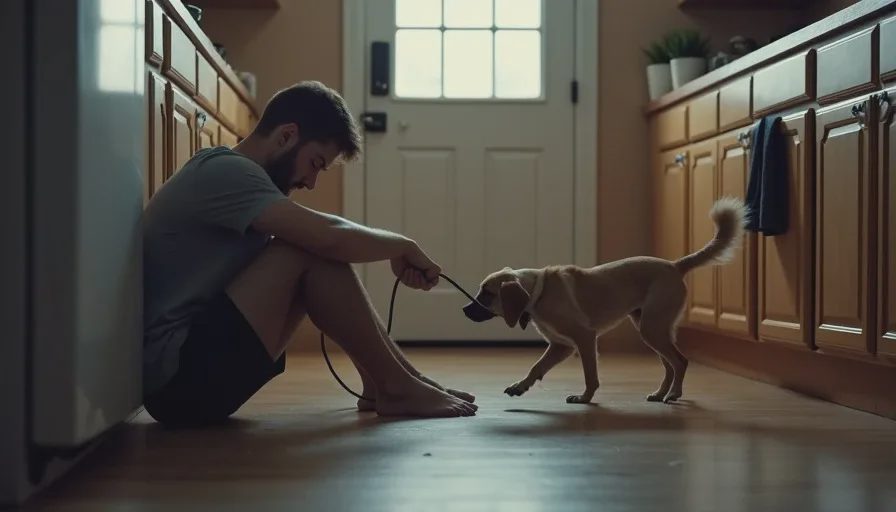
I sat on the kitchen floor that first night, holding a leash I didn't know what to do with, and thought: What have I done?
I learned this one the messy way.
If you're in those first 72 hours right now, feeling like you've made a terrible mistake, let me tell you something I desperately needed to hear:
This is normal. This is temporary. And you are not a bad pet parent.
Here's what those first three days actually looked like—and what I wish I'd known before we brought our rescue home.
Hour 1–6: The Arrival Overload
We brought our dog home from the shelter at 3 PM on a Saturday. She was quiet in the car—too quiet. I thought she was calm. In retrospect, she was frozen in fear.
What happened:
She refused to walk through the front door. I had to carry her.
Once inside, she immediately found the darkest corner of the dining room and wedged herself behind a chair.
She wouldn't look at us. She wouldn't take treats. She wouldn't even drink water.
My daughter was so excited she kept trying to pet her, which made the dog retreat further.
By dinner time, I was exhausted from trying to coax her out, and she still hadn't moved.
What I wish I'd done:
Given her space. I should have set up a quiet corner with a bed, water, and a blanket, and let her come out on her own terms. Instead, I kept hovering, trying to reassure her, which only made her more anxious.
The rule I learned: For the first 24 hours, let your new rescue dog be invisible if they want to. Don't force interaction. Don't hover. Just let them decompress.
Hour 12–24: The Pacing and the Panting
By morning of day two, our dog had finally eaten a few kibble from my hand. I thought that was progress. Then she started pacing. And she didn't stop.
What happened:
She walked in circles around the living room for hours—back and forth, back and forth.
She was panting even though the house was cool.
She couldn't settle in any spot for more than two minutes.
She jumped at every sound—the mail slot, the dishwasher, my phone buzzing.
She refused to go near the crate I'd carefully prepared for her.
What I wish I'd done:
Not panicked. The pacing and panting aren't necessarily signs of a serious problem—they're signs of an overstimulated nervous system. Rescue dogs, especially from shelters, are used to constant noise and movement. Silence and stillness can actually feel scarier to them at first.
The fix I found later: Create a "decompression zone." I put her in a quiet room (the laundry room) with a bed, water, and a chew toy, and closed the door for 30 minutes. It wasn't punishment—it was a reset. When I opened the door, she was calmer. She needed a break from the stimulation of the new house.
Hour 24–48: The Potty Chaos
I thought I was on top of the potty training. I took her out every hour. I praised her when she went outside. But the accidents kept happening.
What happened:
She peed on the rug three times.
She pooped in the hallway, right near the back door.
She'd go outside, stand there looking confused, and then come back in and immediately relieve herself inside.
What I wish I'd done:
Realized she didn't know how to ask to go out. Our dog had never lived in a house before. She had no concept of "inside" vs. "outside" or that she was supposed to communicate her needs.
The fix: I stopped waiting for her to "tell" me. Instead, I set a timer and took her out every 30 minutes—not every hour. And I stayed outside with her until she went, then gave her a high-value treat (cheese!) the second she finished. I also cleaned every accident with enzyme cleaner so she couldn't smell the spot and think it was her bathroom.
By day four, accidents dropped to zero. But those first two days? We went through a lot of paper towels.
Hour 48–72: The Sleep Deprivation
Night two was the hardest.
What happened:
She refused to sleep in her crate. She cried, whined, and scratched at the door.
I tried putting her in my bedroom. She paced all night.
At 2 AM, she started howling—a deep, mournful sound that I'd never heard from a dog before.
I didn't sleep. My daughter didn't sleep. The cat was hiding under the sofa, terrified.
What I wish I'd done:
Not expected her to sleep through the night. Rescue dogs are often used to shelter schedules (lights out early, wake up early). My home's routine was completely foreign to her.
The fix we eventually found: I moved her crate into the living room (not my bedroom), covered it with a blanket to make it feel den‑like, and put a worn t‑shirt of mine inside. I also played soft classical music on a low volume—it masked the sounds of the house and helped her settle.
The first night with that setup? She still whined for 20 minutes. But then she stopped. By night four, she was sleeping through until 6 AM.
The Small Wins (That Kept Me Going)
Those first 72 hours were brutal. But there were tiny moments that gave me hope.
On day two, she licked my hand for the first time.
On day three, she took a treat from my daughter.
On day four, she wagged her tail when I came into the room.
On day five, she voluntarily walked into her crate and lay down.
Each small win felt like climbing a mountain. But they added up.
What I Wish Someone Had Told Me Before Day One
If I could go back and whisper in my own ear before we picked up that rescue dog, here's what I'd say:
1. Expect nothing. Don't expect them to be happy. Don't expect them to be grateful. Don't expect them to love you immediately. They don't know you yet.
2. Lower all standards. Your house will be messy. Your sleep will be interrupted. Your schedule will be thrown off. That's okay. It's temporary.
3. Don't introduce too many people. I made the mistake of having family members come to meet the dog on day two. She was terrified. Now I know: no visitors for at least a week. Let your dog bond with your immediate household first.
4. Skip the big walks. I took her on a long walk on day three, thinking it would tire her out. Instead, she was overwhelmed by the sights, sounds, and smells. Short, quiet walks around the block are plenty for week one.
5. Trust the process. Every rescue dog has a "settling in" timeline. Some adjust in days. Some take weeks. Some take months. Your job is to be consistent, patient, and calm—not to fix them overnight.
The One Thing I'd Do Differently
If I could reset those first 72 hours, I'd do one thing differently:
I'd stop second-guessing myself.
I kept worrying I was doing everything wrong—wrong food, wrong crate, wrong schedule, wrong everything. That anxiety made me inconsistent, which confused the dog.
Now I know: The best thing you can give a new rescue dog is calm, consistent energy. They don't need perfection. They need to know you're in charge and you're not freaking out.
Once I calmed down, she calmed down.
A Letter to Anyone in Those First 72 Hours Right Now
If you're reading this at 3 AM, exhausted, wondering if you made a huge mistake:
I see you. I've been you. And I promise it gets better.
That scared, pacing, howling dog I brought home is now curled up at my feet as I write this. She trusts me. She loves me. She's my best friend. But it took time—and a lot of patience.
Those first 72 hours don't define your relationship. They're just the beginning of a long, beautiful story.
So take a deep breath. Give your rescue dog space. Give yourself grace. And know that tomorrow will be a tiny bit better than today.
You've got this.
What's Next?
Now that we've survived the first 72 hours, the next post is about the feeding station setup that finally reduced spills, stress, and guesswork—because a calm feeding routine makes everything easier.
In the meantime, tell me in the comments: What was the hardest moment in your first few days with a new pet? I'll share my own horror stories right back.
Pin this to your "Rescue Dog Tips" board and share it with anyone who's about to bring a shelter dog home. They'll read it at 2 AM and feel less alone.


Letters
No letters yet. Yours could be the first.